🔬
What is it?
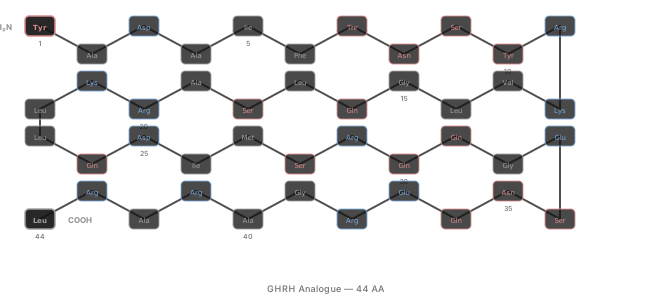
Tesamorelin is a synthetic analog of Growth Hormone Releasing Hormone (GHRH) consisting of the full 44-amino-acid GHRH sequence stabilized with a trans-3-hexenoic acid modification that improves its stability and half-life compared to natural GHRH. Developed by Theratechnologies, Tesamorelin achieved FDA approval in 2010 under the brand name Egrifta for the reduction of excess abdominal fat in HIV-infected patients with lipodystrophy — a metabolic condition where antiretroviral drugs cause characteristic fat redistribution (loss of limb fat, accumulation of visceral abdominal fat).
This FDA approval gave Tesamorelin an unusually strong clinical data set compared to most peptides in this library. Phase III clinical trials documented its effects on visceral adipose tissue (VAT) quantitatively using imaging technology. Beyond its approved indication, Tesamorelin has been studied in broader body composition research and as a tool for investigating the GH axis in aging and growth hormone deficiency states.
📡 Weekly peptide research updates — regulatory updates, new compound profiles, COA alerts.
⚠️ FDA PCAC: -- days left
No spam. Unsubscribe anytime. 7 peptides under review — see what's at stake →
⚡
Why Researchers Care
- Tesamorelin is one of the few peptides in this library with FDA approval and published Phase III clinical trial data — giving it an evidence base that goes beyond animal model research.
- Its documented visceral fat reduction in clinical trials makes it a valuable research tool for studying the relationship between the GH/IGF-1 axis and visceral adipose tissue biology.
- Unlike direct GH administration (which elevates GH to supraphysiological levels), Tesamorelin stimulates endogenous GH release in a more physiologically pulsatile pattern — preserving feedback mechanisms.
- Research has extended to studying Tesamorelin in non-HIV populations with abdominal obesity and in aging-related GH deficiency contexts, where visceral fat accumulation is also a metabolic concern.
- Its well-characterized safety profile from clinical trials provides a reference framework for interpreting findings from related GHRH analog research.
⚙️
How It Works
Tesamorelin binds to GHRH receptors on pituitary somatotroph cells, stimulating the synthesis and pulsatile release of growth hormone. Elevated GH then promotes IGF-1 production in the liver. The net metabolic effect on visceral fat involves IGF-1's ability to promote lipolysis (fat breakdown) in adipocytes, particularly visceral fat cells which appear more responsive to GH/IGF-1 signaling than subcutaneous fat.
The trans-3-hexenoic acid modification protects the peptide from rapid enzymatic degradation by DPP-4 (dipeptidyl peptidase 4), extending its biological half-life and allowing twice-daily dosing in the clinical trial context.
Think of it like this 🧠
Think of visceral fat as a warehouse that grew out of control while the building manager (growth hormone) was on extended leave. Tesamorelin is like calling the manager back to work — not giving someone else the keys (that would be direct GH injection), but stimulating the original manager to resume their normal duties. The pituitary makes more GH, IGF-1 rises in the liver, and the visceral fat warehouses start getting cleared out because the natural management system is running again.
📐
Clinical Protocol Context
Research Disclaimer: The following reflects published clinical and preclinical research and is not medical advice. Consult a licensed healthcare provider before making any health decisions.
Tesamorelin (Egrifta) has one of the best-characterized clinical dosing profiles of any GHRH analog — phase III trials and FDA approval provide large-cohort human data from two randomized controlled trials (ENCORE-1 and ENCORE-2).
Dosing Ranges from Published Research
FDA-Approved (HIV Lipodystrophy)
2 mg SC once daily. The ENCORE-1 trial (Falutz et al., 2010, NEJM) and ENCORE-2 trial (Falutz et al., 2014) used 2 mg/day SC over 26 weeks as the primary protocol, with CT-measured visceral adipose tissue as the primary endpoint. Mean VAT reduction was 15–18% at 26 weeks.
Metabolic Syndrome Research
Stanley et al. (2014, J Clin Endocrinol Metab) studied tesamorelin 2 mg/day SC in HIV-negative adults with abdominal obesity — same dose applied in a different population. IGF-1, VAT, and cognitive endpoints assessed at 26 weeks.
Routes, Duration & Timing
SC — AbdominalOnce-daily SC injection into the abdomen. The FDA-approved protocol specifies rotation of injection sites within the abdominal region.
TimelineIGF-1 rises within the first 4 weeks. Maximum VAT reduction observed at 26 weeks. In extension studies, VAT returned toward baseline after discontinuation (Falutz et al., 2010).
ReconstitutionThe Egrifta formulation is supplied as lyophilized powder with sterile water diluent. Reconstituted solution must be used within 3 hours.
Key References: Falutz J et al. (2010). Tesamorelin HIV lipodystrophy ENCORE-1. NEJM. · Falutz J et al. (2014). ENCORE-2. AIDS. · Stanley TL et al. (2014). Tesamorelin in non-HIV adults. J Clin Endocrinol Metab.
✨
Fun Facts
✅
Tesamorelin (Egrifta) is one of only a handful of peptides in the entire research peptide space that has achieved FDA approval. Most peptides are stuck in preclinical or early clinical stages for decades. The HIV lipodystrophy indication gave it a clear, measurable endpoint (visceral fat by CT scan) that made clinical trial success possible.
📏
In Phase III trials, Tesamorelin produced approximately 15–18% reduction in visceral adipose tissue area as measured by CT imaging over 26 weeks — a quantitative finding that's unusually precise for body composition research.
🔗
The DPP-4 protection mechanism in Tesamorelin (trans-3-hexenoic acid modification) is similar to how GLP-1 analog drugs (like semaglutide) achieve stability — protecting the N-terminal peptide bond from the DPP-4 enzyme that degrades natural GLP-1 and GHRH within minutes.
<\!-- COA & Batch Documentation -->
📋
COA & Batch Documentation
Every batch of Tesamorelin with full Certificate of Analysis documentation. Third-party HPLC verification, mass spectrometry confirmation, and sterility testing results are included with each batch.
📄
HPLC Certificate
Documentation pending batch assignment
🔬
Mass Spec Analysis
Documentation pending batch assignment
✅
Purity Report
Documentation pending batch assignment
🧪
Sterility Test
Documentation pending batch assignment
Learn about our COA verification process →