🔬
What is it?
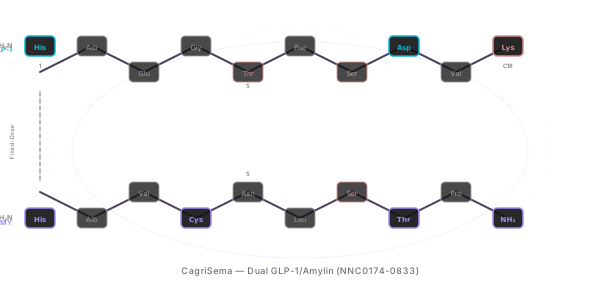
CagriSema (NNC0174-0833) is a fixed-dose co-formulation developed by Novo Nordisk that combines two distinct peptide drugs into a single subcutaneous injection: cagrilintide 2.4mg (a long-acting amylin analogue) and semaglutide 2.4mg (the same GLP-1 receptor agonist used in Wegovy). The two components are co-formulated but pharmacologically independent — each molecule acts on a completely different receptor system.
Cagrilintide activates amylin receptors (AMY1 and AMY3), which are co-assembled from calcitonin receptors (CTR) and receptor activity-modifying proteins (RAMPs). Semaglutide activates GLP-1 receptors in the gut and hypothalamus. These pathways produce overlapping but mechanistically distinct satiety signals, which is the core scientific rationale: hitting two independent appetite-suppressing circuits simultaneously should produce greater and more durable weight reduction than either mechanism alone.
The REDEFINE clinical program published Phase 3 data in the New England Journal of Medicine in 2025, with REDEFINE 1 reporting 22.7% mean body weight loss at 68 weeks in adults with obesity — a result competitive with the best-in-class GLP-1/GIP dual agonists, achieved through a different receptor mechanism entirely.
📡 Weekly peptide research updates — regulatory updates, new compound profiles, COA alerts.
⚠️ FDA PCAC: -- days left
No spam. Unsubscribe anytime. 7 peptides under review — see what's at stake →
⚡
Why Researchers Care
CagriSema is the first major clinical validation of the GLP-1 + amylin combination hypothesis — demonstrating that the amylin pathway adds meaningful independent weight reduction on top of GLP-1 alone. That mechanistic finding has implications beyond CagriSema itself.
- 22.7% mean body weight loss at 68 weeks (REDEFINE 1) — NEJM-published Phase 3 data. For comparison, semaglutide 2.4mg alone (STEP 1) produced ~15% at 68 weeks. The delta suggests cagrilintide's amylin pathway adds approximately 7–8 percentage points of weight reduction over GLP-1 alone.
- First clinical proof of GLP-1 + amylin co-agonism at scale. Amylin (IAPP) is a pancreatic hormone co-secreted with insulin that suppresses glucagon and slows gastric emptying — the same general effects as GLP-1, but via a structurally unrelated receptor. The question of whether amylin adds to GLP-1 efficacy was unresolved before REDEFINE. It does, materially.
- REDEFINE 4 head-to-head vs. tirzepatide: CagriSema 23% vs. tirzepatide 25.5% at equivalent timepoints. Tirzepatide wins narrowly, but CagriSema achieves competitive efficacy through an entirely different second receptor (AMY vs. GIP) — establishing CagriSema as the first alternative to GLP-1/GIP that can match GLP-1/GIP outcomes.
- Dual receptor independence enables mechanistic dissection. Researchers can use CagriSema vs. semaglutide comparisons to isolate the amylin-specific contribution to appetite, gastric emptying, glucagon suppression, and weight trajectory — a pharmacological dissection that wasn't possible before a co-formulated, matched-dose combination existed in clinical trials.
- Regulatory trajectory. FDA submission expected early 2026 with potential approval late 2026. If approved, CagriSema would be the first GLP-1 + amylin combination product in the market — establishing a new receptor target category for metabolic pharmacology research.
⚙️
How It Works
CagriSema operates through two pharmacologically independent receptor systems, both involved in appetite regulation and energy balance, but acting through different circuits in the brain and gut:
Semaglutide arm (GLP-1 receptor): Activates GLP-1 receptors on L-cells in the gut, beta cells in the pancreas, and neurons in the hypothalamus and brainstem. GLP-1 receptor activation suppresses glucagon, stimulates glucose-dependent insulin release, slows gastric emptying, and produces hypothalamic satiety signaling that reduces food intake. These are well-characterized mechanisms shared with the entire GLP-1 agonist drug class.
Cagrilintide arm (Amylin receptors AMY1/AMY3): Activates amylin receptors formed by calcitonin receptor (CTR) + RAMP1 (AMY1) and CTR + RAMP3 (AMY3) complexes. Amylin receptor activation suppresses glucagon secretion (independent of GLP-1's glucagon suppression), slows gastric emptying (via separate brainstem circuits from GLP-1), and generates satiety signals through the area postrema — a brain region that GLP-1 agonists do not primarily target. The combined activation of two distinct satiety-signaling circuits is the mechanistic basis for additive efficacy.
Why cagrilintide specifically: Native amylin (human IAPP) is pharmacologically active but rapidly aggregates and is impractical as a drug. Cagrilintide incorporates multiple modifications (Aib substitutions, fatty acid conjugation for albumin binding, C-terminal amidation) that extend half-life to approximately one week — matching semaglutide's dosing interval and enabling the weekly single-injection co-formulation.
Think of it like this 🧠
Imagine appetite as a security system with two independent alarm circuits. GLP-1 agonists like semaglutide trigger the main alarm — a loud, well-characterized signal that tells your brain "stop eating." The amylin pathway is a second, physically separate alarm in a different part of the building, wired to a different panel. CagriSema triggers both alarms at the same time. Neither circuit knows about the other — they're just both firing simultaneously. That's why the weight loss exceeds what either component alone produces: you can't muffle one alarm by silencing the other.
Receptor Profile vs. Weight Management Comparators
| Compound |
GLP-1R |
GIPR |
AMY1/3 |
GCGR |
Phase 3 Weight Loss |
| Semaglutide |
✓ |
— |
— |
— |
~15% (STEP 1, 68wk) |
| CagriSema |
✓ |
— |
✓ |
— |
22.7% (REDEFINE 1, 68wk) |
| Tirzepatide |
✓ |
✓ |
— |
— |
~22.5% (SURMOUNT-1, 72wk) |
| Survodutide |
✓ |
— |
— |
✓ |
16.6% (SYNCHRONIZE-1, 76wk) |
| Retatrutide |
✓ |
✓ |
— |
✓ |
~26–28% (Phase 2/3 est.) |
Note: Cross-trial comparisons are approximate — trial designs, populations, and timepoints differ. REDEFINE 4 direct head-to-head (CagriSema 23% vs. tirzepatide 25.5%) is the most controlled comparison available.
📐
Clinical Protocol Context
Research Disclaimer: The following reflects published clinical and preclinical research and is not medical advice. Consult a licensed healthcare provider before making any health decisions.
CagriSema (cagrilintide 2.4 mg + semaglutide 2.4 mg) has been evaluated in phase IIb/III trials by Novo Nordisk (REDEFINE program), providing published human dose-escalation and efficacy data from completed RCTs.
Dosing Ranges from Published Research
Phase IIb (REDEFINE-1)
The REDEFINE-1 phase IIb trial (Enebo M et al., 2021, Lancet) studied once-weekly SC co-injection of cagrilintide 0.16–4.5 mg + semaglutide 2.4 mg over 26 weeks with dose escalation. Target maintenance doses studied: cagrilintide 2.4 mg + semaglutide 2.4 mg yielded ~15.6% mean weight loss at 26 weeks.
Phase IIIa (REDEFINE-2)
The REDEFINE-2 phase IIIa trial (NCT05394519) used CagriSema 2.4 mg/2.4 mg SC once weekly for 68 weeks. Preliminary results (2024) documented ~22.7% mean weight loss at 68 weeks.
Routes, Duration & Timing
SC — Once WeeklySubcutaneous co-injection once weekly. 16-week dose escalation period used in clinical trials before reaching maintenance dose. Both compounds in a single pen device in the Phase III formulation.
TimelineMeaningful weight loss (≥5%) observable at 8–12 weeks in research cohorts. Maximum weight loss at 52–68 weeks. Glycemic improvements measurable at 4 weeks.
StoragePrefilled pen device refrigerated (2–8°C). Can be kept at room temperature (<30°C) for up to 6 weeks once pen is in use.
Key References: Enebo M et al. (2021). CagriSema phase IIb REDEFINE-1. Lancet. · REDEFINE-2 NCT05394519 (2024 preliminary data). · Frias JP et al. (2020). Cagrilintide amylin receptor agonism. Lancet Diabetes Endocrinol.
✨
Fun Facts
🧬
CagriSema is the first major clinical validation that amylin receptor agonism adds meaningful, independent weight loss on top of GLP-1 receptor agonism. Amylin receptors (AMY1/AMY3) are structurally unrelated to GLP-1 receptors — the additive effect genuinely comes from hitting a second, independent satiety circuit.
📊
The REDEFINE 4 direct head-to-head comparison (CagriSema 23% vs. tirzepatide 25.5%) is one of the few published head-to-head trials between next-generation obesity agents. Tirzepatide won, but CagriSema achieved competitive efficacy through a fundamentally different second-receptor mechanism — GLP-1 + amylin vs. GLP-1 + GIP.
🕐
Getting cagrilintide and semaglutide into the same vial required matching their half-lives precisely. Native amylin has a half-life of minutes — cagrilintide's Aib substitutions and C18 fatty acid conjugation extend it to ~1 week, matching semaglutide's ~1-week half-life and enabling the once-weekly fixed-dose co-formulation.
📋
COA & Batch Documentation
Every batch of CagriSema (cagrilintide + semaglutide) with full Certificate of Analysis documentation.
📄
HPLC Certificate
Documentation pending batch assignment
🔬
Mass Spec Analysis
Documentation pending batch assignment
✅
Purity Report
Documentation pending batch assignment
🧪
Sterility Test
Documentation pending batch assignment
Learn about our COA verification process →