NAD+
A coenzyme found in every living cell, essential for energy metabolism and DNA repair — and one of the most-studied molecules in the rapidly growing field of aging biology.
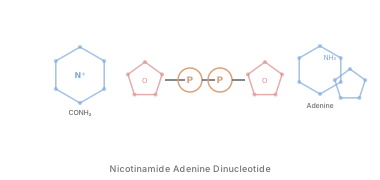
Hover to pause rotation
A coenzyme found in every living cell, essential for energy metabolism and DNA repair — and one of the most-studied molecules in the rapidly growing field of aging biology.
NAD+ (nicotinamide adenine dinucleotide) is not technically a peptide — it's a coenzyme, a small molecule that helps enzymes do their job. But it's included in the research library because it's one of the most important molecules in cell biology and because it functions in closely related research contexts to many of the peptides studied here.
Every cell in your body uses NAD+ as an essential helper molecule. It's the central currency of cellular energy metabolism — shuttling electrons through the reactions that generate ATP (your cells' energy currency). It's also required by sirtuins (proteins linked to longevity research), PARPs (DNA repair enzymes), and CD38 (an enzyme involved in immune signaling). No NAD+, no life — it's that fundamental.
What's changed recently in the research community is a focus on NAD+ levels declining with age. Multiple published studies have documented that NAD+ concentrations fall by 50% or more between youth and old age in multiple tissue types. This decline has been linked in laboratory models to reduced mitochondrial function, impaired DNA repair, and disrupted circadian rhythms. The resulting interest in NAD+ restoration strategies has produced one of the most active research areas in contemporary biology.
NAD+ sits at the intersection of energy metabolism, epigenetics, DNA repair, and aging — making it a uniquely cross-disciplinary research target.
NAD+ accepts electrons from metabolic reactions (becoming NADH), then delivers those electrons to the mitochondrial electron transport chain to generate ATP. As an oxidized coenzyme (NAD+), it also activates sirtuins, which deacetylate histones and other proteins to regulate gene expression, DNA repair, and mitochondrial health. The cycle of NAD+ being reduced (gaining electrons, becoming NADH) and re-oxidized (losing electrons, returning to NAD+) is repeated thousands of times per cell per day — making it one of the most heavily cycled molecules in living systems.
If your cell is a factory, NAD+ is like the forklifts that move materials between departments. Without enough forklifts, the energy production line slows down, the DNA repair team can't get supplies, and the management (sirtuins) can't get to work. When NAD+ levels drop with age, it's like the factory is operating with fewer and fewer forklifts — everything gets slower and less efficient.
Investigación Renuncia de responsabilidad: Lo siguiente refleja investigación clínica y preclínica publicada y no es consejo médico. Consulta a un profesional de la salud licenciado antes de tomar decisiones de salud.
NAD+ has been studied in IV and oral forms across multiple published human trials, most frequently via precursor supplementation (NMN, NR) since direct NAD+ oral bioavailability is limited. IV NAD+ infusion is also used in clinical settings with published protocols.
Referencias Clave: Yoshino M et al. (2021). NMN RCT in overweight women. Science. · Trammell SA et al. (2016). NR dose-response in humans. Nat Commun. · Wan Z et al. (2022). NMN in older adults. Nat Aging.
NAD+ was first discovered in 1906 by Arthur Harden, who won a Nobel Prize for it in 1929 — making it one of the oldest-known coenzymes still actively generating new research findings and clinical trials nearly 120 years later.
NAD+ levels in skeletal muscle drop by approximately 50% between ages 30 and 70 in human studies — a decline rate that has driven enormous investment in NAD+ restoration research and the development of precursor compounds like NMN and NR.
NAD+ is consumed (not just used) by PARP enzymes during DNA repair — a single strand break can consume hundreds of NAD+ molecules. This means significant DNA damage events can temporarily crash a cell's entire NAD+ pool.
Every batch of NAD+ with full Certificate of Analysis documentation.