AOD-9604
A modified fragment of human growth hormone that researchers study for its selective activity on fat cell metabolism — without the growth-promoting effects of full HGH.
Hover to pause rotation
A modified fragment of human growth hormone that researchers study for its selective activity on fat cell metabolism — without the growth-promoting effects of full HGH.
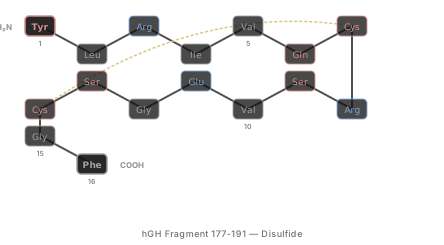
AOD-9604 (Advanced Obesity Drug) is a synthetic peptide derived from the C-terminal end of human growth hormone (HGH) — specifically amino acids 177 through 191. It was originally developed by Metabolic Pharmaceuticals in Australia as a more targeted approach to studying fat metabolism without triggering the full growth-promoting and insulin-desensitizing effects of complete HGH.
Researchers became interested in AOD-9604 because it appeared to isolate the fat-burning properties of HGH in a smaller, more selective molecule. Full HGH has dozens of effects throughout the body; AOD-9604 targets a much narrower slice — the signaling that acts specifically on adipose (fat) tissue. It received GRAS (Generally Recognized as Safe) status from the FDA in 2014 for use in food, making it one of the few peptides with this regulatory designation, though it remains a research compound rather than an approved drug.
📡 Weekly peptide research updates — regulatory updates, new compound profiles, COA alerts.
⚠️ FDA PCAC: -- days leftNo spam. Unsubscribe anytime. 7 peptides under review — see what's at stake →
AOD-9604's appeal to researchers lies in what it doesn't do as much as what it does — it isolates fat metabolism signals from the broader growth hormone system.
7 free research tools built around exactly this kind of compound data. No paywall, no credit card.
AOD-9604 activates beta-3 adrenergic receptors on fat cells — the same type of receptor targeted by the C-terminal region of full HGH. This activation stimulates lipolysis, the process by which fat cells break down stored triglycerides into free fatty acids that can be used for energy. At the same time, research suggests AOD-9604 may inhibit lipogenesis, the process that creates new fat from carbohydrates and other sources. This dual action — more breakdown, less creation — is what makes it interesting for adipose biology research.
Imagine HGH is a Swiss Army knife with 20 different tools. Researchers using the full knife get all the tools at once — useful but complicated. AOD-9604 is like pulling out just the scissors. It's a precision tool that tells fat cells specifically to burn stored energy, without triggering all the other blades. Scientists use it to study what that one tool does on its own, without all the noise from the others.
Research Disclaimer: The following reflects published clinical and preclinical research and is not medical advice. Consult a licensed healthcare provider before making any health decisions.
AOD-9604 was developed by Metabolic Pharmaceuticals in Australia and underwent phase IIb/III trials for obesity, providing published human clinical dosing data from formal pharmaceutical development.
Key References: Heffernan MA et al. (2001). AOD-9604 oral human trial. J Endocrinol. · Ng FM et al. (2000). AOD-9604 fat metabolism in rodents. J Mol Endocrinol. · Metabolic Pharmaceuticals phase IIb data (2004).
AOD-9604 was developed in Australia and went through early-phase human clinical trials there — making it one of the few peptides in this library that has been formally studied in human research subjects as part of a pharmaceutical development program.
It's just 15 amino acids long — making it one of the smallest functional fragments of human growth hormone that researchers have isolated with distinct biological activity. Most of HGH is 191 amino acids; AOD-9604 is the last 15.
Despite receiving FDA GRAS status for food use in 2014, AOD-9604 has never been approved as a pharmaceutical drug. The GRAS designation covers food ingredients — not medical treatments — which is a nuance that often gets misreported in peptide research circles.
Every batch of AOD-9604 with full Certificate of Analysis documentation.