🔬
What is it?
Tesofensine is a small molecule compound — technically not a peptide, but frequently studied alongside peptide research in the metabolic category because it acts on overlapping pathways. It was originally developed by NeuroSearch (a Danish pharmaceutical company) to investigate Alzheimer's disease and Parkinson's disease, where it was studied for its ability to modulate dopamine, serotonin, and norepinephrine levels in the brain.
During those neurological trials, researchers noticed something unexpected: subjects were experiencing significant changes in appetite and body weight. This pivoted Tesofensine's research trajectory toward metabolic science, where it has since been studied in multiple clinical trials for its effects on energy intake and metabolic regulation. It remains an investigational compound with no approved pharmaceutical indication, making it a valuable research tool for studying how neurotransmitter systems intersect with metabolic regulation.
📡 Weekly peptide research updates — regulatory updates, new compound profiles, COA alerts.
⚠️ FDA PCAC: -- days left
No spam. Unsubscribe anytime. 7 peptides under review — see what's at stake →
⚡
Why Researchers Care
Tesofensine is unique in metabolic research because it approaches appetite regulation from the central nervous system rather than from peripheral pathways like the gut hormone systems targeted by GLP-1 agonists.
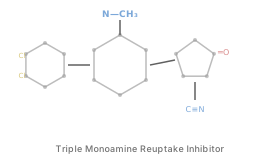
- As a triple reuptake inhibitor hitting dopamine, serotonin, AND norepinephrine simultaneously, Tesofensine allows researchers to study how all three monoamine systems contribute together to appetite and energy regulation — something single-target compounds can't do.
- Its origin in neurological research gives it an unusual dual-relevance: it's used in studies examining the intersection of neurodegenerative disease mechanisms and metabolic regulation, an area of growing scientific interest.
- Phase 2 clinical trial data published in the Lancet (2008) reported significant weight outcomes in research subjects, making it one of the early examples of a centrally-acting compound studied at scale for metabolic endpoints.
- Researchers also study Tesofensine as a comparison tool alongside GLP-1 class compounds — the different mechanistic pathways (central vs. peripheral) help scientists understand which approach produces which biological outcomes.
⚙️
How It Works
Tesofensine inhibits the reuptake of dopamine, serotonin, and norepinephrine — three key neurotransmitters in the brain's reward and appetite-signaling circuits. By blocking reuptake, it keeps these neurotransmitters active in the synapse longer, amplifying their signals. In the context of appetite research, this is thought to reduce food-seeking behavior through multiple pathways simultaneously: dopamine affects reward circuits tied to eating, serotonin influences satiety signaling, and norepinephrine activates sympathetic pathways related to energy expenditure.
Think of it like this 🧠
Imagine your brain has three different radio stations that broadcast "you're satisfied" signals. Most metabolic compounds tune one station at a time. Tesofensine turns up the volume on all three stations simultaneously. The brain hears the "satisfied" signal from more directions at once — which gives researchers a unique way to study how that multi-channel message gets processed compared to single-channel alternatives.
📐
Clinical Protocol Context
Research Disclaimer: The following reflects published clinical and preclinical research and is not medical advice. Consult a licensed healthcare provider before making any health decisions.
Tesofensine reached Phase IIb human clinical trials in obesity research — producing some of the most-cited early dose-finding data in the triple monoamine reuptake inhibitor field. Astrup et al. (2008, The Lancet) enrolled 203 participants with obesity in a 24-week, randomized, placebo-controlled trial, making it the most rigorous clinical data set available for this compound class.
Dosing Ranges from Published Research
0.25 mg/day oral
Low dose arm in Astrup 2008 Lancet Phase IIb — mean weight loss ~6.5% at 24 weeks vs. 2% placebo. Mild adverse effect profile relative to higher doses.
0.5 mg/day oral
Mid-range dose — mean weight loss ~11.3% at 24 weeks. Most studied dose in follow-on investigational contexts; considered the dose producing the best efficacy-tolerability ratio in the Lancet trial.
1.0 mg/day oral
Highest dose arm in Astrup 2008 — mean weight loss ~12.8% at 24 weeks. Increased cardiovascular and CNS adverse events (elevated pulse rate, dry mouth, insomnia, nausea) at this dose level. Phase III development was subsequently deprioritized.
Routes, Duration & Timing
Route
Oral (once daily capsule) in all Phase IIb trials. High oral bioavailability distinguishes it from peptide-based metabolic compounds that require subcutaneous injection.
Duration
24 weeks in the Astrup 2008 primary trial; a 48-week open-label extension (Sjödin et al., 2010, Obesity) tracked continued weight trajectory in completers.
Observed Timeline
Statistically significant weight separation from placebo observed at Week 4. Peak rate of weight loss recorded between Weeks 6–12; rate attenuated as weight loss progressed. Maintained plateau from approximately Week 16 onward in 24-week trial window.
Cardiovascular Monitoring
Astrup 2008 documented mean resting heart rate increases of approximately 7–8 bpm at 1.0 mg/day. All trial participants received blood pressure monitoring at each study visit; hypertension history was an exclusion criterion at the 1.0 mg dose level.
Key References: Astrup A et al. (2008). "Effect of tesofensine on bodyweight loss, body composition, and quality of life in obese patients: a randomised, double-blind, placebo-controlled trial." The Lancet, 372(9653), 1906–1913. Sjödin A et al. (2010). "Tesofensine, a novel triple monoamine reuptake inhibitor, induces substantial weight loss in patients with severe obesity: a randomised, double-blind, placebo-controlled trial." Obesity (48-week extension data).
✨
Fun Facts
🔄
Tesofensine is a rare example of a compound that failed at its original research purpose and succeeded at something completely different — it missed as a neurological drug but generated significant interest in metabolic research. Drug repurposing is a real and productive part of pharmaceutical science.
🧠
Unlike GLP-1 agonists that work primarily through gut and peripheral signaling, Tesofensine acts directly in the brain — specifically in regions like the hypothalamus and nucleus accumbens that regulate hunger and reward. This makes it particularly valuable for studying the neuroscience of eating behavior.
📊
The compound has been studied by multiple academic and pharmaceutical groups across Denmark, the US, and Brazil — making it one of the more internationally-studied metabolic research compounds in its class with data from multiple independent research teams.
📋
COA & Batch Documentation
Every batch of Tesofensine with full Certificate of Analysis documentation.
📄
HPLC Certificate
Documentation pending batch assignment
🔬
Mass Spec Analysis
Documentation pending batch assignment
✅
Purity Report
Documentation pending batch assignment
🧪
Sterility Test
Documentation pending batch assignment
Learn about our COA verification process →