🔬
What is it?
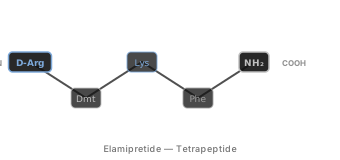
SS-31 (Szeto-Schiller peptide 31) is a synthetic tetrapeptide developed by Hazel Szeto at Weill Cornell Medical College and Peter Schiller at the Clinical Research Institute of Montreal. The "SS" in its name stands for Szeto-Schiller — the two researchers who pioneered the class. It's a cell-permeable peptide with an unusual alternating aromatic-cationic sequence that gives it a unique ability to selectively localize to the inner mitochondrial membrane, specifically binding to cardiolipin — a phospholipid found almost exclusively in that location.
SS-31 advanced into clinical trials under the name Elamipretide (also called MTP-131 or Bendavia) and has been studied in trials for heart failure with preserved ejection fraction, Barth syndrome (a rare mitochondrial disease), and age-related vision loss. It represents one of the most clinically advanced mitochondria-targeted peptides in existence, making it particularly valuable as a research tool for understanding mitochondrial biology in aging and disease contexts.
📡 Weekly peptide research updates — regulatory updates, new compound profiles, COA alerts.
⚠️ FDA PCAC: -- days left
No spam. Unsubscribe anytime. 7 peptides under review — see what's at stake →
⚡
Why Researchers Care
SS-31 is arguably the most precision-engineered peptide in the longevity research space — it doesn't just target mitochondria broadly, it homes in on a specific location within the mitochondrial membrane.
- Its selective binding to cardiolipin — a phospholipid critical to mitochondrial membrane architecture and electron transport chain function — makes it an extraordinarily precise research tool. Cardiolipin disruption is implicated in aging, heart failure, and neurodegeneration, and SS-31 allows researchers to study what happens when you selectively stabilize it.
- Unlike most antioxidants that distribute broadly throughout the body, SS-31 concentrates thousands-fold in the inner mitochondrial membrane — the exact location where most reactive oxygen species (free radicals) are generated during energy production. Researchers use it to study site-specific antioxidant interventions.
- Its clinical trial history gives it one of the most robust human safety and tolerability datasets of any peptide in the longevity research category, and the published clinical data from multiple trials provides context for interpreting preclinical research findings.
- SS-31 has been studied across remarkably diverse research contexts: heart failure, kidney injury, eye disease, skeletal muscle aging, and general mitochondrial dysfunction models — making it a versatile probe for understanding mitochondrial biology across different tissues.
⚙️
How It Works
SS-31 enters cells freely and is drawn to the inner mitochondrial membrane by electrostatic interactions with cardiolipin, where it concentrates and stabilizes the membrane architecture. Cardiolipin normally works with cytochrome c (a key protein in the electron transport chain) to facilitate efficient electron transfer during ATP production. When mitochondria are stressed, cardiolipin oxidizes and releases cytochrome c, disrupting energy production and triggering cell death pathways. SS-31 binds to cardiolipin, protecting it from oxidation, keeping cytochrome c in place, and helping maintain efficient electron transport. The result in model systems is improved mitochondrial efficiency, reduced reactive oxygen species generation, and improved cellular energy production under stress conditions.
Think of it like this 🧠
Imagine a factory floor where all the power cables run. Over time, the cable insulation wears down — connections get loose, sparks fly, and the factory loses efficiency. SS-31 is like an electrician who goes straight to the exact cables that matter most (cardiolipin, in the inner membrane), patches the insulation, and keeps the connections tight. Other antioxidants are like security guards walking the whole building looking for sparks — SS-31 goes directly to the source of the problem. Researchers study it because fixing the wiring directly is a fundamentally different approach than cleaning up sparks after they happen.
📐
Clinical Protocol Context
Research Disclaimer: The following reflects published clinical and preclinical research and is not medical advice. Consult a licensed healthcare provider before making any health decisions.
SS-31 (Elamipretide/MTP-131/Bendavia) has progressed through phase II human trials for cardiac and skeletal muscle indications, providing published clinical dosing data from formal pharmaceutical development.
Dosing Ranges from Published Research
REVIVED Cardiac Trial
The REVIVED-BCIS2 trial (McDonagh et al., 2022, NEJM) administered SS-31 (Elamipretide) as 0.05 mg/kg IV infusion over 1 hour. This RCT enrolled 347 patients with ischemic cardiomyopathy. The phase I/II PROGRESS-HF study used 0.005–0.25 mg/kg/day SC for 4 weeks (Gibson et al., 2016, JACC Heart Fail).
Mitochondrial Disease
Phase II MMPOWER-3 trial for Barth syndrome used 40 mg/day SC over 12 weeks (Bharat Biotech, 2020). Published open-label studies used 40 mg/day SC as standard dose.
Routes, Duration & Timing
IV InfusionUsed for acute cardiac applications. 1-hour infusion protocol in the REVIVED-BCIS2 cardiac ischemia trial.
SC — DailyUsed in mitochondrial disease and heart failure trials. Once-daily SC injection in PROGRESS-HF and MMPOWER studies.
TimelineCardiac endpoints (EF, 6-min walk) assessed at 4 weeks. Exercise capacity endpoints measured at 12 weeks. Mitochondrial disease functional outcomes measured at 12 weeks.
Key References: McDonagh TA et al. (2022). SS-31 REVIVED cardiac trial. NEJM. · Gibson CM et al. (2016). PROGRESS-HF. JACC Heart Fail. · Szeto HH (2014). SS-31 preclinical review. Pharm Res.
✨
Fun Facts
🎯
SS-31 concentrates approximately 1,000-fold in the inner mitochondrial membrane compared to the surrounding cell. This extraordinary selectivity isn't achieved by actively pumping the molecule there — it's entirely driven by the molecule's chemistry interacting with cardiolipin's unique properties. Engineering that level of precision into a four-amino-acid sequence is considered one of the elegant achievements of peptide chemistry.
❤️
SS-31 (as Elamipretide) is one of the few peptides in the longevity research space to reach Phase 2 and Phase 3 clinical trials for multiple indications. It has been tested in human subjects with heart failure, making it significantly more clinically validated than most peptides in this research category.
🧪
Research in aged mice has shown that SS-31 can partially reverse age-associated declines in mitochondrial function in skeletal muscle — not just protect against further decline but actually improve function in already-aged tissue. This "rejuvenation" rather than "protection" framing has made it particularly interesting to aging biologists.
📋
COA & Batch Documentation
Every batch of SS-31 with full Certificate of Analysis documentation.
📄
HPLC Certificate
Documentation pending batch assignment
🔬
Mass Spec Analysis
Documentation pending batch assignment
✅
Purity Report
Documentation pending batch assignment
🧪
Sterility Test
Documentation pending batch assignment
Learn about our COA verification process →