⚖️
2026 Regulatory Update — PCAC Hearing July 23
TB-500 is among the most directly impacted peptides in the current FDA regulatory cycle. Two significant events have occurred in 2026, with a third on the horizon.
Key Regulatory Events
Pre-2026
TB-500 classified under FDA Category 2 — bulk substances that present safety risks and are inappropriate for compounding. Compounding pharmacies prohibited from use.
Apr 15, 2026
Federal Register notice FR Doc. 2026-07361 (Docket FDA-2025-N-6895) removes TB-500 from Category 2. This ends the explicit prohibition but does not authorize compounding — TB-500 is not yet on the 503A Bulk Drug Substances List.
Jul 9, 2026
Public comment deadline for the PCAC hearing docket on TB-500 (and other peptides). Final opportunity for researchers and clinicians to submit data for committee consideration.
Jul 23, 2026
FDA Pharmacy Compounding Advisory Committee (PCAC) Day 1 hearing. TB-500, BPC-157, and KPV are on the agenda for evaluation for the 503A Bulk Drug Substances List. PCAC is advisory — its recommendations are not binding.
Late 2026
PCAC formal recommendations expected. A positive recommendation requires subsequent FDA rulemaking — not an immediate regulatory change.
2027
Estimated implementation window if FDA adopts a positive PCAC recommendation and completes the required rulemaking process.
What the Removal from Category 2 Actually Means
Removal from Category 2 ≠ legalization of compounding. Category 2 removal ends an explicit prohibition; it does not place TB-500 on the affirmative 503A list that governs what compounding pharmacies may use. The PCAC hearing and subsequent FDA rulemaking are the remaining steps required before compounding would be legally authorized.
Political context: The MAHA movement and RFK Jr.'s elevated role at HHS have increased public attention to peptide access. The PCAC process is formal and evidence-based — political attention may accelerate timelines but does not substitute for the committee's independent evaluation or the rulemaking process that follows.
TB-500 remains Research Use Only on this platform regardless of compounding status. Regulatory changes to compounding pharmacy rules do not affect RUO research access.
📡 Weekly peptide research updates — regulatory updates, new compound profiles, COA alerts.
⚠️ FDA PCAC: -- days left
No spam. Unsubscribe anytime. 7 peptides under review — see what's at stake →
🔬
What is it?
TB-500 is a synthetic peptide derived from a specific region of Thymosin Beta-4 (Tβ4) — a small protein that is one of the most abundant molecules inside virtually every cell in your body. Thymosin Beta-4 is a 43-amino-acid protein that was first isolated from thymic tissue (hence the name), but researchers quickly discovered it's far more widespread than just immune tissue. It's found in high concentrations in platelets, wound fluid, and almost all nucleated cells.
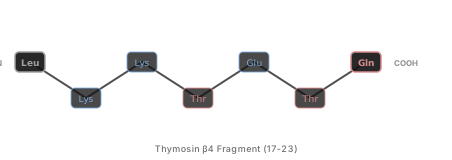
The "TB-500" designation refers to a specific active fragment of the Thymosin Beta-4 molecule that is believed to retain the key biological activity while being easier to synthesize and study. The specific fragment that makes TB-500 is the LKKTETQ peptide sequence — a short actin-binding domain that does a lot of the heavy lifting in Tβ4's biological effects.
What drew researchers to Thymosin Beta-4 originally was its unusually high concentration at wound sites and in developing tissue. Wherever repair is happening in the body, Tβ4 tends to show up in elevated levels. That correlation sparked decades of research into what it's actually doing at those sites and whether synthetic versions could be useful research tools.
⚡
Why Researchers Care
TB-500 / Thymosin Beta-4 has attracted significant research attention because it sits at a critical junction of several biological repair processes simultaneously:
- It's one of the primary regulators of actin — the protein that forms the structural skeleton inside cells and is essential for cell movement, cell division, and wound closure. TB-500 sequesters G-actin monomers, affecting the dynamics of how cells move and reorganize.
- Research has documented its effects on promoting migration of endothelial cells, keratinocytes, and fibroblasts — three key cell types involved in wound closure and tissue repair.
- TB-500 has been studied in cardiac repair models, where Tβ4 has shown potential to promote cardiomyocyte (heart muscle cell) survival and support repair after ischemic injury in animal models.
- Anti-inflammatory activity has been documented across multiple tissue systems, making it a compound of broad interest in injury and recovery research contexts.
⚙️
How It Works
TB-500's primary mechanism centers on actin dynamics. Inside every cell, actin exists in two forms: G-actin (free globular units) and F-actin (long polymerized filaments that form the cell's internal skeleton). TB-500 binds to G-actin monomers and sequesters them, which regulates the balance between these two forms. This is important because the cell's ability to change shape, move, and divide depends critically on controlling this balance.
Beyond actin regulation, TB-500 interacts with integrin signaling pathways, which govern how cells sense and interact with their surrounding tissue environment. It upregulates matrix metalloproteinases (enzymes that help clear damaged tissue) and promotes expression of VEGF, which drives new blood vessel formation into healing tissue. The result is a peptide that affects repair at multiple levels: cellular movement, structural remodeling, and vascular supply simultaneously.
Think of it like this 🧠
Imagine cells as workers who need to physically walk across a construction site to do their jobs. TB-500 is like providing those workers with better shoes AND clearing the debris from their path. The "shoes" (actin regulation) help cells move more efficiently; the "path clearing" (ECM remodeling) removes the obstacles blocking cell migration to the damage site. Then it also calls in the water truck (VEGF/angiogenesis) to keep everything running.
📐
Clinical Protocol Context
Research Disclaimer: The following reflects published clinical and preclinical research and is not medical advice. Consult a licensed healthcare provider before making any health decisions.
Thymosin Beta-4 (TB-500's precursor peptide) has advanced to human clinical trials for cardiac and wound healing indications, providing relatively rare clinical dosing data for a research peptide. The following summarizes parameters from published preclinical and human research.
Dosing Ranges from Published Research
Cardiac (Human Trial)
Phase IIa LILAC trial (Elamipretide precursor research group) and separate Tβ4 cardiac studies administered Thymosin Beta-4 IV in doses ranging from 0.5–42 mg over 7–28 days in post-MI patients. The LILAC study (Sopko et al., 2018, JACC: Basic Transl Sci) documented safety across doses.
Wound Healing
Phase II wound healing trial (RegeneRx) studied Tβ4 topically as RGN-352 (0.03–0.1% formulations) and SC injection (1.2–6.4 mg/injection) over 12-week protocols for chronic wounds and corneal injury (Sosne et al., 2010, Cornea).
Preclinical (Animal)
Rodent and equine preclinical studies have used 25–150 mg/kg in systemic healing models. Equine tendon studies administered 10–50 mg per treatment site via injection (Dahlgren et al., 2010, Equine Vet J).
Administration Routes Studied
Intravenous
Used in human cardiac trials for systemic distribution. IV administration was the route for acute post-MI applications where systemic delivery was needed.
Subcutaneous
Used in wound healing and musculoskeletal repair protocols. SC administration studied in both rodent and human pilot settings.
Topical
Phase II trials used Tβ4 topically for wound healing and corneal repair, demonstrating effective local penetration and action without systemic administration.
Intra-lesional
Direct injection into healing sites studied in equine tendon repair research (Dahlgren et al., 2010).
Study Durations & Observed Timelines
Days 1–14
Wound healing rate improvements measurable at 14-day endpoints in chronic wound studies. Corneal epithelial healing showed accelerated closure within 7–14 days in the RGN-355 eye drop trials (Sosne et al., 2010, Cornea).
Weeks 4–12
Cardiac function endpoints (EF, wall motion) assessed at 4-week intervals in the LILAC cardiac trial. Equine tendon repair studies ran 12 weeks with structural improvements confirmed by ultrasound and histology.
Reconstitution & Storage Context
Thymosin Beta-4 in research settings is reconstituted from lyophilized form using bacteriostatic water or sterile saline. The RegeneRx clinical formulations (RGN-352 injectable) used standard pharmaceutical excipients for injectable preparations. Lyophilized TB-500/Tβ4 is documented stable at −20°C with protection from repeated freeze-thaw cycles. Solution stability at 4°C is generally cited as days to a few weeks — lyophilized storage preferred for longer durations.
Frequency & Timing
The human cardiac trial used acute single-dose or short-course IV administration. Wound healing studies used intermittent injection protocols (twice-weekly in some protocols). Equine preclinical studies used once- to twice-weekly local injections over 4–12 weeks. No published research has established optimal injection frequency for systemic musculoskeletal research in humans — protocols varied significantly across published studies.
Key References: Sopko N et al. (2018). Cardiac Tβ4 trial LILAC. JACC: Basic Transl Sci. · Sosne G et al. (2010). Thymosin beta 4 corneal wound healing. Cornea. · Dahlgren LA et al. (2010). Tβ4 equine tendon repair. Equine Vet J. · Goldstein AL et al. (2012). Thymosin Beta-4 review. Ann NY Acad Sci.
✨
Fun Facts
❤️
TB-500 / Thymosin Beta-4 was studied in clinical trials for cardiac repair — specifically after heart attacks — making it one of the few peptides in this category to advance to human trials for a serious cardiac indication. That research is ongoing.
🏆
Thymosin Beta-4 is actually detected in equine (horse) blood and has appeared on prohibited substance lists for horse racing. This gave it an unexpected profile boost in sports science research communities who became curious about its mechanisms.
🧫
Tβ4 is one of the most abundant intracellular proteins in mammals — it makes up roughly 0.5% of total cellular protein in some cell types. Something this abundant clearly has important housekeeping functions beyond just wound repair.
📋
COA & Batch Documentation
Every batch of TB-500 with full Certificate of Analysis documentation. Third-party HPLC verification, mass spectrometry confirmation, and sterility testing results are included with each batch.
📄
HPLC Certificate
Documentation pending batch assignment
🔬
Mass Spec Analysis
Documentation pending batch assignment
✅
Purity Report
Documentation pending batch assignment
🧪
Sterility Test
Documentation pending batch assignment
Learn about our COA verification process →