🔬
What is this stack?
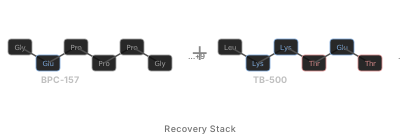
The BPC-157 + TB-500 stack is arguably the most studied peptide combination in preclinical healing research. BPC-157 (Body Protection Compound-157) is a synthetic 15-amino-acid peptide derived from a gastric protective protein, while TB-500 is a synthetic fragment of Thymosin Beta-4 — one of the most abundant proteins found in mammalian cells.
What makes this combination particularly interesting to researchers is that these two peptides appear to operate through different but overlapping pathways. BPC-157 excels in localized tissue signaling — it's been heavily studied in tendon, ligament, muscle, and gut tissue models. TB-500's primary claim to research interest is its role in systemic actin regulation and cell migration, which affects healing across a much broader range of tissue types and is particularly studied in cardiac and wound-healing contexts.
Together, researchers study whether combining localized signaling (BPC-157) with systemic repair mobilization (TB-500) produces outcomes that neither compound achieves alone — a potential complementary mechanism that's driven substantial interest in this pairing within the preclinical literature.
📡 Weekly peptide research updates — regulatory updates, new compound profiles, COA alerts.
⚠️ FDA PCAC: -- days left
No spam. Unsubscribe anytime. 7 peptides under review — see what's at stake →
⚡
How They Work Together
Understanding why researchers study these compounds together requires understanding what each does independently — and where those functions intersect.
BPC-157 operates primarily through local signaling mechanisms: it upregulates growth hormone receptors on fibroblasts (the cells that build connective tissue), promotes angiogenesis (new blood vessel formation) via VEGF upregulation, modulates the nitric oxide system, and exerts anti-inflammatory effects on local tissue environments. Its mechanism is fundamentally about making the immediate repair environment more effective.
TB-500 (Thymosin Beta-4) works primarily through actin regulation. Actin is the protein that forms the internal skeleton of cells, and it's critical to cell migration — the process by which repair cells physically move to an injury site. TB-500 sequesters G-actin, which drives significant downstream effects: it promotes cell motility, hair follicle development, blood vessel formation, and is one of the few peptides studied in cardiac repair models for its effects on cardiomyocyte migration and survival.
Think of it like this 🧠
Imagine tissue repair like rebuilding a neighborhood after a storm. BPC-157 is the construction crew — skilled workers who show up at the specific damaged building, fix it from the inside out, and make sure the local infrastructure (plumbing = blood vessels, electricity = nitric oxide signaling) is working. TB-500 is the supply convoy — it operates on the highway system, moving more workers, equipment, and raw materials to all damaged neighborhoods simultaneously. You need the crew doing detailed local work AND the supply chain keeping materials flowing. One without the other is slower. Together, the site gets rebuilt faster from both ends.
📖
Why Researchers Pair These
The research interest in this combination comes from the complementary nature of the two pathways:
- Different primary targets, overlapping outcomes: BPC-157 operates heavily through growth hormone receptor pathways and nitric oxide; TB-500 operates through actin/G-actin regulation and LMNA gene expression. Both result in improved cell migration and tissue repair — but via routes that don't cancel each other out.
- Angiogenesis from two directions: Both compounds promote formation of new blood vessels, with BPC-157 acting via VEGF and TB-500 via its effect on endothelial cell and smooth muscle migration. Researchers examine whether dual-pathway angiogenesis produces more robust vessel formation in models.
- Connective tissue diversity: BPC-157 has unusually broad tendon, ligament, and gut tissue data. TB-500 has strong cardiac, corneal, and wound healing data. Pairing them in research models allows examination of synergy across different tissue categories in the same subject.
- Anti-inflammatory compatibility: Both compounds have been studied for anti-inflammatory properties via different cytokine pathways — BPC-157 through COX-2 and NF-κB modulation, TB-500 through thymosin-mediated immune signaling. Researchers study whether this dual approach produces additive effects without interaction toxicity.
Explore each compound's standalone research profile for full mechanism breakdowns, published study summaries, and COA documentation:
✨
Fun Facts
🧬
Thymosin Beta-4 (the parent peptide of TB-500) is one of the most abundant proteins in mammalian cells — your body makes it constantly. TB-500 is the synthetic research fragment. BPC-157, meanwhile, comes from studying the stomach's ability to protect itself from its own acid. Two very different biological origins, studied together for tissue repair.
❤️
TB-500 is one of the few peptides with significant cardiac repair research — studies have examined its effects on cardiomyocyte migration after ischemic injury. BPC-157 research, by contrast, is dominated by musculoskeletal and gut models. This means the pairing covers tissue types that neither alone addresses as thoroughly.
📚
BPC-157 alone has over 300 published preclinical studies — mostly from Croatian research institutions who've been investigating it since the early 1990s. It remains the most-studied synthetic peptide in the healing category by publication volume.