🔬
What is this stack?
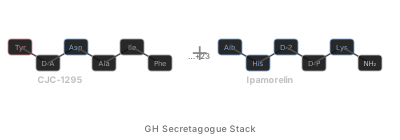
The CJC-1295 + Ipamorelin stack targets growth hormone secretion through two completely independent receptor systems simultaneously — a research design that's generated significant interest because of what's called "dual-pathway synergism" in the GH secretion literature.
CJC-1295 is a GHRH (Growth Hormone-Releasing Hormone) analog. GHRH is the body's natural "go" signal for GH release from the pituitary — it binds GHRH receptors and tells the pituitary to produce and release growth hormone. CJC-1295 includes a DAC (Drug Affinity Complex) modification that dramatically extends its half-life from minutes to days by binding albumin in the bloodstream, making it a long-acting GHRH signal.
Ipamorelin is a GHRP (Growth Hormone-Releasing Peptide) — specifically, the most selective GHRP in widespread research use. It works via a completely different receptor: the ghrelin receptor (GHSR-1a). Ghrelin is the body's hunger hormone, but its receptor also controls natural pulsatile GH release. Ipamorelin's selectivity is notable — it doesn't trigger cortisol, prolactin, or significant appetite stimulation that complicate older GHRPs like GHRP-6.
📡 Weekly peptide research updates — regulatory updates, new compound profiles, COA alerts.
⚠️ FDA PCAC: -- days left
No spam. Unsubscribe anytime. 7 peptides under review — see what's at stake →
⚡
How They Work Together
The fundamental reason researchers study this combination is dual-pathway activation. The pituitary gland releases GH via two distinct mechanisms that work independently and additively:
- GHRH pathway (CJC-1295): Binds GHRH receptors on somatotrophs (GH-producing pituitary cells), activating adenylyl cyclase and cAMP signaling, which drives GH synthesis and release.
- Ghrelin/GHSR pathway (Ipamorelin): Binds ghrelin receptors, activating a different second messenger cascade (PKC/IP3) that independently triggers GH release — and also suppresses somatostatin, the body's natural "stop" signal for GH.
Think of it like this 🧠
Imagine the pituitary's GH release like a door with two separate locks that must both be open for the door to open fully. CJC-1295 opens Lock 1 (the GHRH receptor) by pressing the "go" button from the outside. Ipamorelin opens Lock 2 (the ghrelin receptor) by simultaneously pressing a different go button AND disabling the alarm that would normally shut the door again (somatostatin suppression). With both locks open at the same time, the door swings wider than either key alone could manage. That's why researchers study this combination — it's not just additive, it may be synergistic because of the somatostatin inhibition component.
📖
Why Researchers Pair These
- True receptor independence: GHRH receptors and ghrelin receptors (GHSR-1a) are distinct proteins with distinct signaling cascades. Activating both simultaneously in research models explores whether non-overlapping pathways produce additive or synergistic GH output.
- Somatostatin suppression: Ipamorelin (via ghrelin receptor) reduces somatostatin — the body's natural GH "off" signal. This means CJC-1295's GHRH stimulation encounters less opposition when Ipamorelin is also present. The research literature describes this as "amplification" of the GHRH response.
- Selectivity profile: Ipamorelin's lack of cortisol and prolactin stimulation makes it a cleaner research tool than older GHRPs. Researchers can study GH-pathway effects without confounding cortisol elevation that makes data interpretation harder.
- Pulsatility research: The body releases GH in natural pulses. Researchers study whether the CJC-1295 + Ipamorelin combination preserves pulsatile GH release patterns (more physiological) vs. creating a flat sustained GH signal — a question with meaningful implications for downstream IGF-1 and tissue research models.
- IGF-1 research: GH stimulates hepatic IGF-1 production, which mediates many of GH's downstream effects. This stack is studied in models examining IGF-1 elevation and its downstream effects on nitrogen balance, fat metabolism, and tissue anabolism.
Explore each compound's standalone research profile for full mechanism breakdowns, published study summaries, and COA documentation:
✨
Fun Facts
🔬
The discovery that GHRH and GHRP pathways are independent and additive was a major finding in endocrinology research. Before this was understood, researchers assumed GH secretion was controlled by a single axis. The two-lock model fundamentally changed how the field studied pituitary function.
🎯
Ipamorelin's selectivity was considered remarkable when it was developed — earlier GHRPs like GHRP-6 caused significant cortisol spikes that complicated research interpretation. Ipamorelin essentially isolated the ghrelin-receptor GH signal for the first time, making dual-pathway research much cleaner.
⏱️
CJC-1295 without DAC has a half-life of about 30 minutes (similar to natural GHRH). CJC-1295 with DAC extends this to approximately 6–8 days by piggybacking on albumin in the bloodstream. This is achieved by a single reactive ester group added to the peptide chain — a clever pharmaceutical chemistry trick.