🔬
What is this stack?
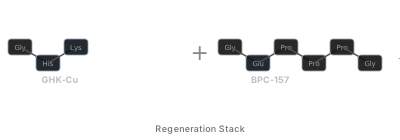
GHK-Cu (Glycyl-L-Histidyl-L-Lysine copper complex) is a naturally occurring tripeptide that was first isolated from human plasma. It's been studied extensively for its remarkable ability to modulate gene expression at scale — research has suggested it influences the expression of over 4,000 human genes, affecting collagen synthesis, inflammation pathways, DNA repair mechanisms, and antioxidant systems. It's one of the most-studied compounds in skin science and wound biology.
BPC-157, as regular visitors to this library know, is a 15-amino-acid synthetic peptide derived from gastric protective proteins, studied for localized tissue repair, angiogenesis, and anti-inflammatory effects across a wide range of tissue types.
What makes this pairing interesting to researchers is that these two compounds approach tissue regeneration from fundamentally different levels of biology: GHK-Cu operates at the gene expression level — it changes what instructions cells are reading; BPC-157 operates at the signaling level — it changes what signals cells are receiving from their environment. Together, researchers study whether gene-level reprogramming plus signaling-level activation produces more comprehensive tissue regeneration outcomes in models.
📡 Weekly peptide research updates — regulatory updates, new compound profiles, COA alerts.
⚠️ FDA PCAC: -- days left
No spam. Unsubscribe anytime. 7 peptides under review — see what's at stake →
⚡
How They Work Together
These two compounds operate at different levels of the cellular hierarchy, which is what makes their combination so interesting to study:
GHK-Cu works primarily through gene expression modulation. It binds to specific cell surface receptors and activates signaling cascades that affect the transcription of hundreds of genes simultaneously. Key studied effects include: collagen and elastin synthesis upregulation, metalloproteinase (MMP) modulation (controlling how old collagen is broken down), anti-inflammatory cytokine balance, and antioxidant gene activation. It essentially reprograms cells toward a more regenerative gene expression profile.
BPC-157 works primarily through signaling cascades: VEGF-mediated angiogenesis, growth hormone receptor upregulation on fibroblasts, nitric oxide system modulation, and anti-inflammatory cytokine effects. It creates a repair-friendly signaling environment at the extracellular level.
Think of it like this 🧠
Imagine rebuilding a city block after damage. GHK-Cu is the zoning law revision — it changes the rules at the planning level so that every builder in the area is now required to use better materials, follow upgraded safety codes, and prioritize structural integrity. These are changes that affect every construction project in the zone. BPC-157 is the general contractor on the specific damage site — showing up, calling in the supply trucks (blood vessels), signaling the skilled workers, and managing the repair site directly. The zoning revision means the contractor is working under better rules. The contractor means the zoning revision actually gets executed on the specific damaged site. Both levels need to work.
📖
Why Researchers Pair These
- Complementary collagen work: GHK-Cu is studied for both collagen synthesis (building new collagen) and MMP modulation (controlled degradation of old/damaged collagen, which is required for healthy remodeling). BPC-157 promotes angiogenesis that delivers the oxygen and nutrients required for collagen production. These mechanisms support rather than duplicate each other.
- Different scales of action: GHK-Cu affects gene expression across hundreds of genes simultaneously — a broad upstream effect. BPC-157 acts on specific signaling pathways at the tissue repair site — a targeted downstream effect. Researchers study whether broad upstream gene reprogramming plus targeted downstream signaling produces outcomes neither achieves alone.
- Angiogenesis from different angles: Both compounds promote blood vessel formation, but via different pathways. GHK-Cu upregulates angiogenic genes; BPC-157 directly promotes VEGF expression. Researchers study whether dual-mechanism angiogenesis produces more robust vascularization in wound models.
- Skin + systemic repair research: GHK-Cu has its deepest research base in skin and wound healing contexts. BPC-157 has broader research across tendon, gut, and nerve tissue in addition to skin. Together, they're studied in multi-tissue models where the skin-specific depth of GHK-Cu complements the systemic breadth of BPC-157.
- Anti-inflammatory compatibility: Both have studied anti-inflammatory properties via different cytokine pathways. GHK-Cu affects inflammatory gene expression; BPC-157 modulates NF-kB and COX-2 signaling. Researchers study whether dual-mechanism inflammation modulation reduces interference with the healing process more effectively than either alone.
Explore each compound's standalone research profile for full mechanism breakdowns, published study summaries, and COA documentation:
✨
Fun Facts
🧬
GHK-Cu was discovered by Loren Pickart in the 1970s during research on liver regeneration. He noticed that young human plasma restored liver function better than old plasma, and isolated GHK as the responsible component — before anyone knew it could bind copper or modulate gene expression. The copper-binding discovery came later.
🧠
Research suggests GHK-Cu may influence the expression of over 4,000 human genes — including genes associated with DNA repair, antioxidant systems, collagen production, and anti-inflammatory pathways. This breadth of gene expression modulation from a simple tripeptide is considered one of the most remarkable findings in peptide biology.
🔬
BPC-157 has been studied in tissue types as diverse as tendon, ligament, muscle, gut, cornea, and nervous system — an unusual breadth for a single peptide. GHK-Cu has been studied in skin, wound tissue, brain, and hair follicle contexts. Together, the tissue coverage of this pairing spans nearly every major tissue category, which is part of why it appears in so many multi-tissue research designs.