🔬
What is this stack?
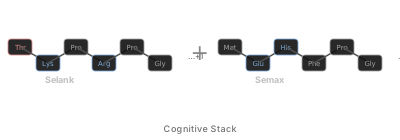
Selank and Semax are both peptides developed in Russia by the Institute of Molecular Genetics and related institutions, and both have been studied for effects on the central nervous system. What makes this pairing interesting to researchers is that while both are classified as nootropic peptides, they appear to work through largely distinct mechanisms — and those mechanisms target complementary aspects of cognitive function and neuroprotection.
Selank is a synthetic analog of tuftsin, a naturally occurring immune peptide, extended with an additional peptide sequence to increase its stability. Investigación has focused on its influence on the GABAergic system (the brain's primary inhibitory signaling network) and its effects on BDNF (Brain-Derived Neurotrophic Factor) expression. It has been studied in anxiety-related research models and is notable as one of the few peptides examined in clinical settings in Russia for anxiety-related conditions.
Semax is derived from ACTH (Adrenocorticotropic Hormone) — specifically a 4-7 fragment that lacks the hormonal activity of full ACTH but retains what researchers believe are the neuroprotective signaling properties. It's been studied extensively for BDNF upregulation, neuroprotection against ischemic damage, and cognitive enhancement. Semax is approved as a pharmaceutical in Russia for use in stroke recovery contexts.
⚡
How They Work Together
Both peptides converge on BDNF — but from different upstream pathways, which is a key reason researchers study them together:
- Selank modulates the GABAergic system and increases BDNF expression via pathways related to its tuftsin-derived activity. It also affects serotonin transport and enkephalin degradation enzyme activity — giving it a profile that spans anxiety regulation, mood signaling, and neurotrophic factor production.
- Semax primarily upregulates BDNF and NGF (Nerve Growth Factor) via ACTH-fragment receptor interactions, and has been studied for direct neuroprotective effects in ischemia models — protecting neurons against oxidative stress and excitotoxicity.
Think of it like this 🧠
Think of the brain as a busy research university. Selank is the administration department — it reduces bureaucratic noise (anxiety signaling, excessive GABAergic imbalance) so that researchers can focus. It creates a calmer, more organized environment. Semax is the research funding office — it increases the budget for building new laboratories (BDNF = neural growth factor = synaptic plasticity and neurogenesis). When the environment is calm AND well-funded, the university produces more. Neither calm nor funding alone is as powerful as both together.
📖
Why Investigacióners Pair These
- Complementary BDNF pathways: Both compounds increase BDNF, but Selank does so through GABAergic/serotonergic modulation while Semax does so through ACTH-receptor and direct neurotrophic factor pathways. Investigacióners study whether these independent upstream routes produce additive BDNF output in CNS models.
- Anxiety + neuroprotection: Selank has been more studied in anxiety and stress-response models; Semax in neuroprotection and stroke recovery models. Combining them allows researchers to study whether anxiolytic properties and neuroprotective properties can be studied simultaneously without pathway interference.
- Enkephalin stability: Selank is noted for inhibiting enzymes that degrade enkephalins (endogenous opioid peptides involved in mood regulation). This mechanism has no overlap with Semax's ACTH-fragment activity, meaning the two compounds operate independently on the opioidergic system vs. the neurotrophic factor system.
- Shared Russian research heritage: Both compounds emerged from the same institutional research environment, meaning there is an unusually large body of literature studying them together as part of Russian nootropic peptide research programs — more so than most international peptide pairings.
- Minimal receptor competition: Unlike many peptide combinations that compete for the same receptors, Selank and Semax act on largely distinct receptor families. This means they can be studied together without the pharmacokinetic interference that complicates many combination research designs.
Explore each compound's standalone research profile for full mechanism breakdowns, published study summaries, and COA documentation:
✨
Datos Interesantes
🇷🇺
Both Selank and Semax have achieved pharmaceutical status in Russia — Selank for anxiety-related indications, Semax for stroke recovery and cognitive decline. This level of clinical development is rare for nootropic peptides internationally and gives both compounds an unusually strong research foundation compared to most novel peptides.
🧬
Selank was designed by adding the tripeptide Gly-Pro-Pro to tuftsin — a modification that dramatically extended its half-life in the body and added CNS-active properties not present in tuftsin alone. The fact that a three-amino-acid addition could so dramatically change a peptide's activity profile is a useful illustration of how sensitive peptide biology is to small structural changes.
💭
BDNF (Brain-Derived Neurotrophic Factor) is sometimes called "fertilizer for the brain" in popular science — it promotes neuronal growth, differentiation, and survival, and is strongly linked to learning and memory consolidation. Both Selank and Semax have been studied for BDNF upregulation through different routes, making this stack a notable dual-mechanism BDNF research model.