🔬
What is it?
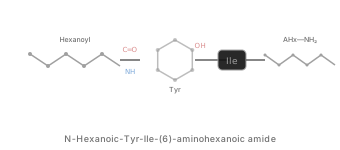
Dihexa is a small molecule peptide derived from angiotensin IV — a fragment of the renin-angiotensin system, which most people associate with blood pressure regulation. Investigacióners at Washington State University discovered that by modifying this fragment, they created a compound with remarkable activity in the brain, operating through a completely different pathway than the cardiovascular effects people normally associate with angiotensin.
It works through the HGF/MET system — a signaling pathway that promotes synapse formation and neuronal connection growth. This makes it a structurally unusual research compound: it looks like a cardiovascular molecule, but its research interest is almost entirely neurological.
⚡
Por qué interesa a los investigadores
Dihexa occupies a unique position in cognitive research: it targets a mechanism (HGF/MET signaling) that most cognitive compounds don't touch, and it does so at concentrations that have surprised researchers with their potency in laboratory models.
- Dihexa has been studied for its extraordinary potency in promoting synaptogenesis — the formation of new synaptic connections between neurons — with some published research describing it as orders of magnitude more potent than BDNF by mass
- It targets the HGF/MET signaling pathway, which is distinct from most other cognitive research compounds, giving researchers a novel and largely unexplored mechanism to investigate
- Laboratory studies have examined its effects in models of cognitive decline, including research contexts related to Alzheimer's disease pathology
⚙️
How It Works
Dihexa binds to HGF (Hepatocyte Growth Factor) and facilitates its interaction with the MET receptor. This signaling cascade promotes the formation of dendritic spines — the tiny protrusions on neurons where synaptic connections form and information is exchanged. More spines, more connections; more connections, more capacity for learning and memory encoding.
Think of it like this 🧠
Imagine neurons are Lego builders who want to connect their creations but keep dropping their connection pieces. HGF is like a helpful assistant who holds the pieces in place so the builders can snap them together. Dihexa might work like a turbo-charged version of that assistant — making it far easier and faster for neurons to form stable, lasting connections before the moment passes.
📐
Contexto de Protocolo de Investigación
Investigación Renuncia de responsabilidad: Lo siguiente refleja investigación clínica y preclínica publicada y no es consejo médico. Consulta a un profesional de la salud licenciado antes de tomar decisiones de salud.
Dihexa research protocols come exclusively from the McCoy group at Washington State University. No human clinical trials have been conducted. Published data is preclinical — rodent cognitive and memory models with detailed dose-response documentation.
Dosing Ranges from Published Investigación
Rodent Cognitive Studies
McCoy et al. (2013, J Pharmacol Exp Ther) used Dihexa 1 mg/kg/day subcutaneously in aged rat memory impairment models. Object recognition and spatial memory (Morris water maze) showed significant improvement vs. vehicle at 2-week treatment. The same group used 10 mg/kg/day as a maximum dose to establish therapeutic index.
Neurogenesis Investigación
Studies examining hippocampal neurogenesis used Dihexa 0.1–10 mg/kg IP over 7–14 day protocols. BrdU immunohistochemistry used to quantify new cell production.
Routes, Duration & Timing
SC / IP / OralSC primary in rodent memory studies. Oral bioavailability documented — Dihexa is notable among peptides for being orally active, enabling non-injection rodent protocols. IP used for more precise dose delivery in mechanistic studies.
TimelineBehavioral effects in spatial memory tasks measurable at 7–14 days of administration. Neurogenesis endpoints measured at 14–21 days.
StatusNo published human clinical data as of 2026. Dihexa's lipophilicity and oral bioavailability are considered advantages for potential future clinical development.
Referencias Clave: McCoy AT et al. (2013). Dihexa in aged rat memory impairment. J Pharmacol Exp Ther. · Wright JW & Harding JW (2015). Dihexa HGF/c-Met axis and cognitive function. Physiol Behav.
✨
Datos Interesantes
🎓
Dihexa was developed at Washington State University — it's one of the few novel cognitive peptides to emerge from a US academic research program, making it a rare domestically-originated entry in this category.
🔗
It works through the HGF/MET pathway — the same signaling system involved in organ development, tissue regeneration, and wound healing. The brain taps into this same ancient system for building and maintaining neural architecture.
⚗️
At extremely small concentrations (nanomolar range), Dihexa has shown measurable effects on synapse formation in laboratory studies. Investigacióners are still actively investigating why such tiny amounts produce such significant impacts on neuronal connectivity.
<\!-- COA & Batch Documentation -->
📋
Documentación COA y de Lotes
Every batch of Dihexa with full Certificate of Analysis documentation. Third-party HPLC verification, mass spectrometry confirmation, and sterility testing results are included with each batch.
📄
HPLC Certificate
Documentation pending batch assignment
🔬
Mass Spec Analysis
Documentation pending batch assignment
✅
Purity Report
Documentation pending batch assignment
🧪
Sterility Test
Documentation pending batch assignment
Learn about our COA verification process →