🔬
What is it?
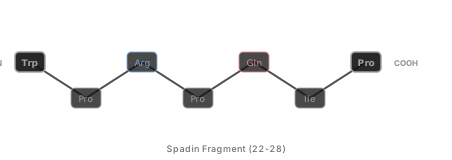
PE-22-28 is a synthetic peptide fragment derived from spadin — itself a peptide derived from sortilin, a protein naturally expressed in the brain. The research story here is genuinely unusual: scientists discovered that the sortilin protein releases a small peptide fragment called spadin, which appears to block a potassium channel in the brain called TREK-1. That was an unexpected finding, because sortilin is known for sorting proteins into cellular compartments — not for releasing mood-relevant peptides.
PE-22-28 is a refined, shorter version of spadin that researchers designed to study this TREK-1 blocking mechanism more precisely and with improved stability compared to the original spadin fragment.
⚡
Por qué interesa a los investigadores
The TREK-1 potassium channel is a relatively underexplored target in mood disorder research. Most classical research in this area focuses on monoamine systems — serotonin, dopamine, norepinephrine. PE-22-28 opens a completely different mechanistic door.
- TREK-1 channels are potassium channels in the brain that, when active, suppress certain neurotransmitter activity — blocking them has been studied as a potential approach to mood disorders through a non-monoamine pathway
- PE-22-28 appears to act faster in laboratory studies than many traditionally studied antidepressant mechanisms, where most classical mechanisms studied involve weeks of neurochemical adjustment before effects are observed
- It has been studied in relation to neuroplasticity — specifically hippocampal neurogenesis, which refers to the growth of new neurons in the memory and emotion center of the brain
⚙️
How It Works
PE-22-28 blocks TREK-1 potassium channels. When these channels are open, they hyperpolarize neurons — making them less likely to fire electrical signals. By blocking TREK-1, PE-22-28 allows neurons to fire more readily, particularly in circuits involved in mood regulation and cognitive processing. Downstream, this appears to influence serotonergic signaling and may promote hippocampal neurogenesis.
Think of it like this 🧠
Picture a concert hall where the musicians keep hitting a mute pedal on their instruments whenever they try to play. TREK-1 channels are like that mute pedal — constantly dampening the signal before it gets through. PE-22-28 works like someone who removes the mute pedal entirely — suddenly the musicians can play at full volume again, and the music (neural signals) can travel through the circuit clearly and completely.
📐
Contexto de Protocolo de Investigación
Investigación Renuncia de responsabilidad: Lo siguiente refleja investigación clínica y preclínica publicada y no es consejo médico. Consulta a un profesional de la salud licenciado antes de tomar decisiones de salud.
PE-22-28 is a recently characterized SPADIN analog. Investigación protocols are derived from Bhatt, Bhatt, Moha ou Maati, and Bhatt-Bhatt group publications (2018–2023). Clinical human data does not yet exist — published protocols are exclusively preclinical.
Dosing Ranges from Published Investigación
Rodent Antidepressant Models
Borsotto et al. (2015, EMBO Mol Med) and Moha ou Maati et al. (2012, Neuropharmacology) used intraperitoneal PE-22-28 at 1–10 mg/kg in forced swim test and chronic unpredictable stress models. Antidepressant-like effects observed at 3 mg/kg IP within 30 minutes in acute assays.
Chronic Administration
14-day chronic stress models used daily IP injections of 5 mg/kg. Neurogenesis endpoints (BrdU+ cells in hippocampus) assessed at study endpoint (Borsotto et al., 2015).
Routes, Duration & Timing
IP / SCIntraperitoneal injection primary in published rodent models. SC also used for chronic protocols. No oral bioavailability data published.
TimelineAcute behavioral effects in FST measured at 30–60 min post-injection. Neurogenesis/hippocampal endpoints assessed at 14 days.
StatusNo published human clinical data as of 2026. All dosing reference points are preclinical rodent models.
Referencias Clave: Borsotto M et al. (2015). SPADIN/PE-22-28 antidepressant effects. EMBO Mol Med. · Moha ou Maati H et al. (2012). TREK-1 and depression. Neuropharmacology.
✨
Datos Interesantes
🐠
TREK-1 channels were first widely studied in fish and amphibians — they're one of the most evolutionarily ancient potassium channels in the nervous system. The fact that they're also present in the human brain, regulating mood, is a striking example of how evolution reuses old machinery for new purposes.
🧬
PE-22-28 traces its origin to sortilin — a protein your brain produces and uses mainly for routing other proteins to the right cellular compartments. The discovery that sortilin also releases a mood-relevant peptide fragment was a genuine scientific surprise, not a designed outcome.
⚡
In some laboratory models, the onset of observed effects in PE-22-28 studies has been measured in hours rather than weeks — a sharp contrast to the timeline typically seen with classical mechanisms studied in mood disorder research. Investigacióners find this timeline distinction particularly interesting.
<\!-- COA & Batch Documentation -->
📋
Documentación COA y de Lotes
Every batch of PE-22-28 with full Certificate of Analysis documentation. Third-party HPLC verification, mass spectrometry confirmation, and sterility testing results are included with each batch.
📄
HPLC Certificate
Documentation pending batch assignment
🔬
Mass Spec Analysis
Documentation pending batch assignment
✅
Purity Report
Documentation pending batch assignment
🧪
Sterility Test
Documentation pending batch assignment
Learn about our COA verification process →